What comes to mind when you envision Montana? Perhaps it’s wild and scenic mountain landscapes, awe-inspiring geography, rivers that carve deep canyons lined with dense coniferous forest, or glaciers, geysers, and vibrant thermal pools. Indeed, Western Montana’s portion of the Rocky Mountains often takes center spotlight when it comes to the surrounding world’s perception of Montana. Yet in reality, 60% of Big Sky Country is prairie. In the 8 years I’ve called this state home, I’ve met plenty of Western Montanans that seem to regard our sprawling plains and rural communities like the weird, estranged relatives that you just don’t bring up at family dinner. The longer you spend in the prairie, though - and the longer you spend getting to know the people who sustain it - the more viscerally you understand its vitality to us all.
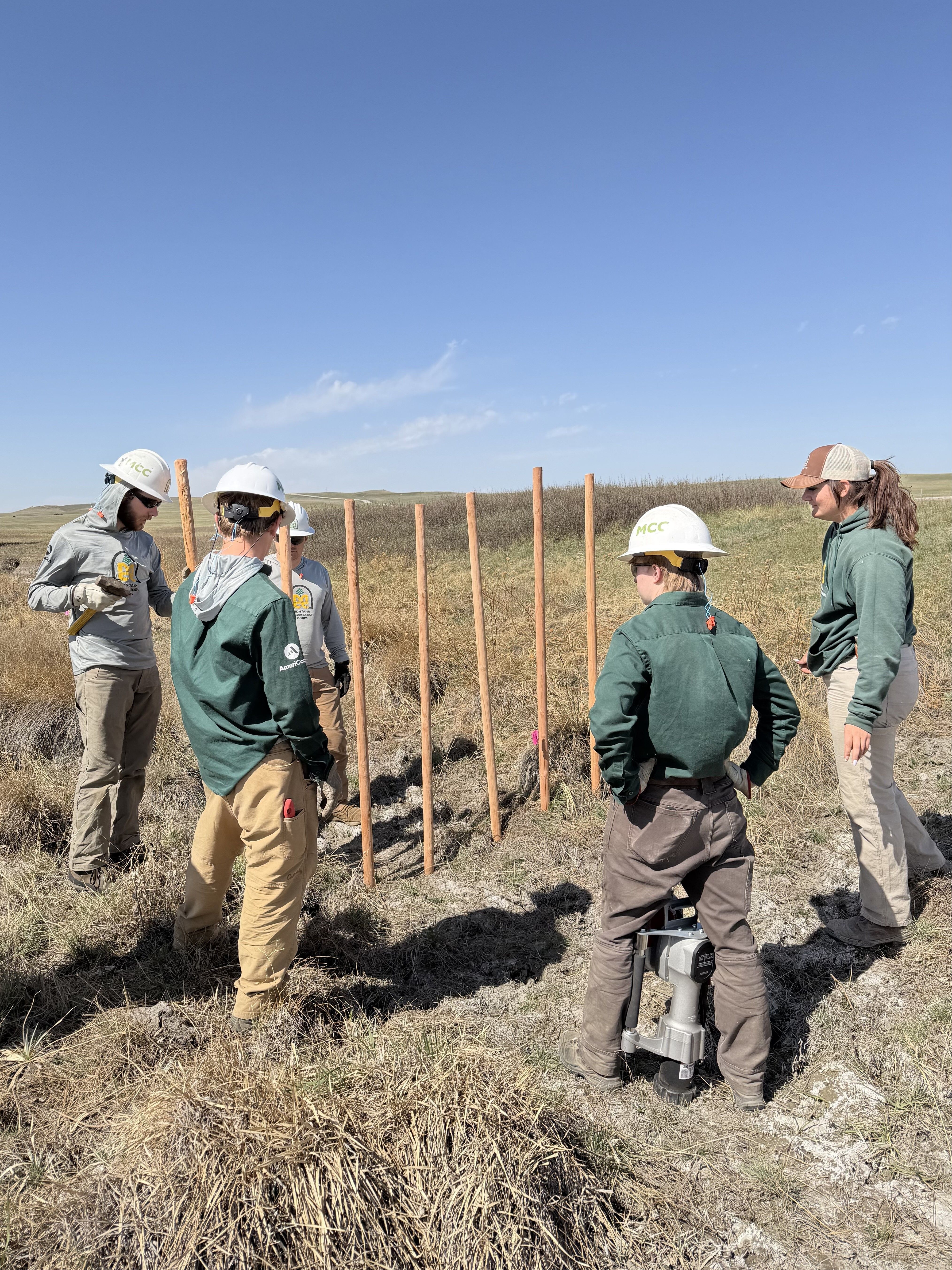
Conserving that vitality requires weaving and fostering a dynamic web - one where ranchers, landowners, conservation organizations, indigenous people, and living systems work closely together, with the knowledge and resources of each collaborating towards long-term ecological restoration goals. For the past 9 days, myself and my fellow Wildland Restoration Team (WRT) Crew Leads from our Missoula and Kalispell offices had the privilege of being welcomed into this collaboration. The result, for me, was falling in love with mesic restoration, and falling in love with the prairie.
Regan Ware and Autumn Holzgen, our Low-Tech, Process-Based Restoration (LTPBR) experts, taught us everything we now know about mesic restoration. We learned that within a damaged, incised stream system, we can create a series of structures that mimic natural ones (like beaver dams, hello!) in order to help slow down water flow, improve water retention, and increase sediment deposition. This encourages groundwater recharge and raises the local water table - which, in turn, supports the recovery of riparian vegetation, wildlife habitat, and improved water quality.
Healing (in this case, and perhaps in a much broader sense, too) is based not only on bringing life back, but on establishing a resilient and biodiverse system that will eventually be self-maintaining. Our dream is to transform a degraded stream into habitat so irresistible to beavers that they come back and keep doing our work for us.
There’s a slew of structures that fall under the LTPBR umbrella for mesic restoration. Regan and Autumn taught us that each stream system will call for a different and diverse combination of structures; each structure will work in collaboration across the entirety of the system to slow water, create pools, increase complexity, reduce scouring, induce meandering, and restore floodplain connectivity. A good mixture of LTPBR structures in a degraded stream system offers the same lesson that a healthy riparian ecosystem does: resilience is founded on strengthening the relationship between diversity and collaboration. Just like within our own communities, we can’t just plop one individual structure in our system and expect it to thrive and do the work of healing the whole stream on its own.
The first step to succeed in Process-Based Restoration (and perhaps the most important one) is to find good teachers. Over the course of our hitch, we were lucky enough to find many (although they really found us - our big white trucks are hard to miss). Each brought their own gifts to share. Around every corner of this hitch, we were met by passionate educators who also came equipped with delicious baked goods, home-cooked meals that came directly from the land, and the type of kindness, generosity, and humility that leaves a mark on you and makes you want to turn around and run back to the prairie as soon as you’ve left.
Perhaps our most influential teacher throughout the week was Lisa Schmidt. Lisa is the owner and rancher behind Graham Ranch (also known as A Land of Grass Ranch), a beautiful expanse of native prairie nestled between Blackfeet Nation and Conrad, MT. Lisa raises the most delicious grassfed beef and lamb I’ve ever tasted, on top of selling fine wool products that come straight from sheep sheared on the ranch. Before our hitch, though, myself and the other WRT crew leads knew only the following things about Lisa: 1) Her name was Lisa, 2) She was letting us camp on her ranch while we built LTPBR structures on one of her streams that might (but probably didn’t) have water, 3) She wanted us to set up our tents near an old house on the ranch that might (but might not) provide us access to drinking water, a toilet, a shower, and a kitchen, and 4) she had at least two guard dogs that were really good at their jobs.
As with many experiences I embark on, I didn’t have many expectations for our crew’s interactions with Lisa. I enjoy entering experiences with minimal expectations, mostly because I’ve found that it allows for more wonder to find me. So, I expected that we’d interact with Lisa in at least some regard while we were there, at the very least to say hello when we arrived and thank you when we left. I hoped we’d get to know her a little bit. That’s about as far as I got.
I did not expect, then, for Lisa to become one of the most incredible people I’ve ever met, for her to spend many, many hours throughout our hitch teaching us crew leads how she knows, loves, and stewards a landscape, and for her to foster one of the most wonder-filled weeks I’ve had in recent memory. From the first moment we arrived at Graham Ranch until the moment we left, Lisa treated us like we were a part of her family. We quickly learned that the “old house” we’d be camping next to did, in fact, have running water, a toilet, and a kitchen - plus two bedrooms, two living spaces, and a glorious heater. Having access to even one of these amenities on hitch is a luxury and a privilege, but access to all of these things on hitch? Unprecedented. History-making. Likely won’t happen again for the rest of our season (sorry, members). In the genuine sort of way that feels rarer and rarer these days, Lisa told us to make ourselves at home. So we did.
The “old house,” as it turns out, was actually really old - it was constructed in 1906 as a home to Alistair Graham’s parents. To Lisa, and now to our WW and NRock WRT crew leads, it is lovingly called “Grandma’s House.” For 9 days, Grandma’s House sheltered us from the cold, provided us sweeping views of the surrounding prairie and open skies, and created a space to feel like we belonged in “a land of grass.” We asked her questions about the ranch, and each story she told lit up the room. We soon learned that Lisa was on the precipice of lambing season, and that her ewes would likely start giving birth a few days into our hitch. When the first three bums (orphaned lambs) were born, Lisa came to find us at Grandma’s House. “Do you want to help me feed the babies?” she asked. How could we say no?
She taught us how to gently hold a lamb in our lap, fold its legs underneath itself, and guide a bottle to its mouth with the correct angle. Each of us had the gift of holding or feeding a lamb over several days and watching the bums get better and better at using the bottle. Lisa gently and patiently showed us the way each time.
On Saturday, after we’d completed around half of our planned structures on the stream, Lisa invited us to her home to share a meal with her parents and her partner, Erik, who owns a ranch nearby. She and her mom had prepared two stews for us, one of lamb and one of beef (both, of course, that Lisa raised) As we walked into her kitchen, she reminded us to make ourselves at home.
We gathered around the dining room table, and as I took my first spoonful of lamb stew, I wondered if I’d ever have a meal that delicious on hitch again. As the evening progressed, we shared more stories, and Lisa shared more about her journey as a rancher, writer, and conservationist. I asked her for advice on writing, life, and learning to ride horses. “Don’t ever let anyone tell you that you can't pursue something you love,” she told me. We all listened to Erik and Max pluck the mandolin against the setting sun and made plans to visit Erik’s ranch later in the hitch. On Monday, Lisa drove us there, and after Erik told us the story of the ranch and showed us around, he turned to us with a grin. “You guys get to be cowboys for the morning,” he said. We all smiled at each other, and followed Lisa and Erik as they guided us through herding teenage bulls into a new pasture. It was exhilarating, dynamic, connective, and a story I’ll be telling my grandchildren (and my members this season). When the last cow made it through the gate, Lisa smiled at us. “That’s what we call a success,” she said.
As our time at Graham Ranch and Grandma’s House grew, and as more LTPBR structures went up on the dry streambed we worked on, Lisa’s enthusiasm and gratitude for our project never once faltered. We learned how hard the current, years-long drought had hit her and other ranchers in the Northern Great Plains. The section of stream we were working to restore hadn’t seen flowing water in two years. The groundwater spring that’s historically fed the stream has dried up, the water table no longer reaching it as the drought has prevailed. For Lisa and many other ranchers, whether or not it starts to rain soon is a life or death matter for the ranch. In 9 days, our WRT crew leaders completed 34 structures on that streambed. In 9 days, Lisa and her loved ones brought us all closer to that landscape. Combining the nature of LTPBR with a landowner (and human) like Lisa, and getting more and more invested in her ranch as each day passed created an environment where I’ve never felt more connected to the importance of the work our team was doing. |