![[Image Description: Two MCC members taking a brief break; one is sitting on a rock, the other is standing nearby. They are both in their uniforms, looking out at the expansive, mountain view surrounding them.]](https://cdn.firespring.com/images/c3f85e97-43a9-4810-8081-e8e6338173d0.jpeg)
If you’d asked me earlier in my last season with MCC on a Beaver crew, if I would return for another season of the same work, I probably would have looked at you funny. Yet here I am, about a year from the beginning of that season, on the same piece of land that started my journey as a Beaver. As I lie sliding off my sleeping pad inside my tent, which itself has become the new perch for a particularly chatty Meadowlark, I realize that there’s no other place I would rather be.
Okay, maybe my perfect setting isn’t sideways in a pasture surrounded by cow patties, but the sentiment still stands.
In early 2025, desperate for a change, I reached out to an old friend, whom I knew worked out of Helena in the summer, about a position with their employer. After some interviews and conversations with different folks, I was directed to MCC’s Central Divide office. Specifically their mesic restoration program- colloquially known as Beavers. Some more interviewing later, and I was accepted for a position. I packed up my sedan with everything I could fit, and left my barista job in St. Louis for Helena.
If you’re still wondering what a Beaver crew is, so was I. It made about as much sense to me as it did my neighbor when I told him I build beaver dams. Let me explain: Beaver crews utilize a technique called Low-Tech Process-Based Restoration (LTPBR). This technique emphasizes the use of local, non-invasive, and other natural materials to build in-stream structures. A majority of these structures are referred to as Beaver Dam Analogs, or BDAs. And unlike other restoration crews, Central Divide Beavers get the unique opportunity of working on full term LTPBR stream restoration crews.
So yeah, building beaver dams. It’s almost as glamorous as it sounds. From seven to five every day, myself and three others worked under the prairie sun building these structures to help rejuvenate the stream, the water table, and surrounding land.
These vast mixed-grass prairies, shaped by ages of unrelenting wind and weather patterns, make up about 56 million acres (60 percent!) of the state of Montana, and over 100 million acres in surrounding states. This expanse is home to around 2,200 different species of flora and fauna, yet this landscape remains particularly at risk. Decreased rainfall, snowmelt conditions, and historic overgrazing have contributed to the degradation of prairie wetland systems, and a large majority of these systems rely on intermittent and ephemeral streams as their primary water source.
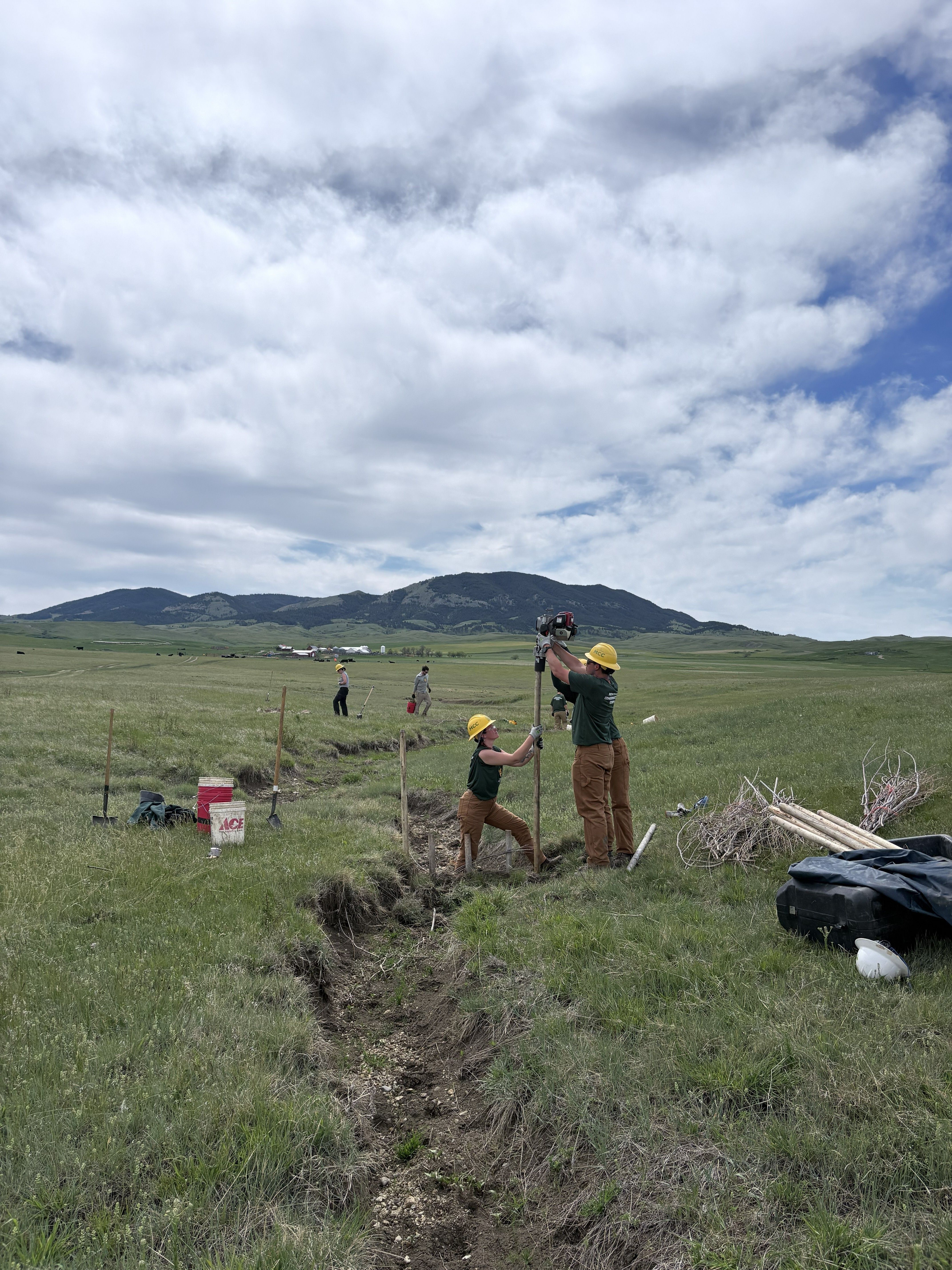
And it was through months of oft unforgiving wind and rapidly changing weather that I truly felt the gravity of our work. On its surface, Beaver work is a lot of pounding posts, digging buckets full of dirt, and getting yourself stuck in deep, less-than-pleasant smelling stream beds. Days of persistent re-coating of bug spray and sunscreen and hauling posts, shovels, hammers and other tools through knee-high vegetation. But more than that, it’s teamwork and building a better land for future generations. It’s keeping it simple and learning from everything you see. It’s learning the full history and native wisdom of the land and aligning to work towards a common goal.
And sometimes it’s the look on your neighbors face when you tell them you build beaver dams.
I write this in my second term as a Beaver, reflecting on my drastic change in feelings from this time last year. A change I owe to the enthusiasm of my crew members, the other Beavers, my regional staff, and all the Northern Great Plains Program staff. A change I owe to the hardworking ranchers, farmers, tribal nations and other community members whose questions make me so excited and push me to learn more. A change I owe to LTPBR’s accessibility and subsequently growing number of passionate Beavers.
It can be dirty, it doesn’t smell very good, and you’ll be well acquainted with the local wildlife of all sizes, but you’ll leave with a true connection to your crew mates, to the Earth, and to a beautiful, often overlooked, and deeply sacred landscape.
Pictured: CD Crew 8 member Brianna Poulin and CD Crew 7 members Trey Martin and Jade Valdez pound posts for a willow structure. Photo courtesy of Jenna Davis.